
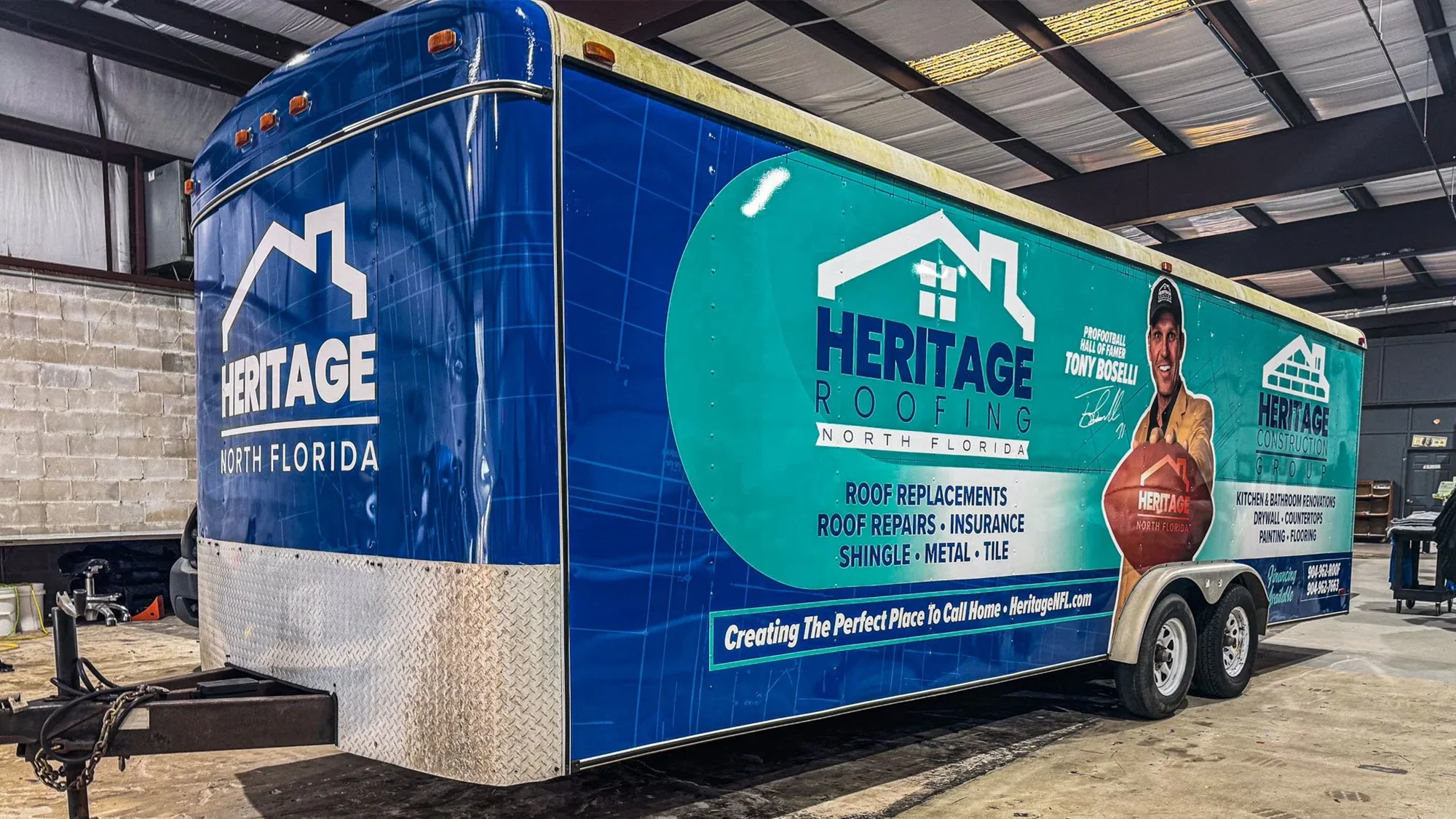
Trailer Wraps in Sugar Land
Trailer wraps in Sugar Land are large-format vinyl graphics applied to enclosed, utility, cargo, and specialty trailers. They turn unused exterior space into a visible business asset while helping protect the original finish from everyday exposure. For local companies that already drive through Sugar Land, Stafford, Missouri City, and the Houston area, a wrapped trailer can keep the business name, services, and contact information in front of potential customers without adding another advertising platform.
Key Takeaways:
- A trailer wrap can advertise a business wherever the trailer is driven, parked, or used at a job site.
- Clear lettering, simple messaging, and strong contrast matter more than filling every panel with information.
- Surface condition, trailer shape, material quality, and installation skill all affect the finished result.
- A well-planned wrap should match the rest of the company’s branding and remain readable from a practical distance.
- Working with a vehicle wrap and sign shop helps avoid design choices that look fine on a screen but fail on the road.
Table of Contents

What Trailer Wraps Actually Do
A trailer already takes up visual space. A wrap makes that space useful. Instead of showing a plain white, black, or aluminum surface, the trailer can display a company name, phone number, website, services, and brand colors in a way that feels connected to the rest of the business.
For many companies, trailer wraps in Sugar Land work as a moving business card. They’re seen in traffic, outside homes, near commercial properties, and at job sites. Even when the trailer is parked, the graphics can continue working without requiring anyone to hand out a flyer or explain what the company does.
At GWraps, we approach trailer graphics as part of a company’s full vehicle and signage presence. The goal isn’t to cover every inch with text. It’s to make the trailer easy to recognize and easy to understand.
How a Trailer Wrap Differs From Basic Lettering
Basic lettering can be a practical choice when a business only needs a name and phone number. A full or partial wrap offers more room for color, photography, textures, logos, service descriptions, and stronger visual contrast.
The right option depends on the trailer, the business, and how the trailer is used. A landscaping company may need bold service wording and a large phone number. A catering company may benefit from clean food imagery and a polished brand presentation. A contractor may want something tougher and more straightforward. The design should fit the company instead of forcing every business into the same layout.
Why Sugar Land Businesses Use Trailer Wraps
Sugar Land has a mix of residential neighborhoods, commercial developments, medical offices, retail centers, construction activity, and service-based businesses. Trailers move through all of those areas every day. That creates repeated visibility in places where customers already live and work.
Trailer wraps in Sugar Land can make sense for contractors, home service companies, event businesses, food service operators, landscapers, restoration companies, mobile service providers, and equipment-based businesses. The trailer doesn’t have to be on the road all day to be useful. A few regular routes and visible parking locations can create steady local exposure over time.
Visibility Matters More Than Design Complexity
A complicated wrap isn’t automatically a better wrap. Drivers and pedestrians usually have limited time to look at a trailer. The main information should register quickly.
A strong trailer design usually has one clear visual direction. The company name should be easy to find. The phone number should be large enough to read. Service wording should be limited to what matters most. Decorative elements can support the message, but they shouldn’t compete with it.
We’ve seen trailer graphics lose impact because the design tried to include too much. Small paragraphs, long service lists, several logos, and multiple calls to action can make the trailer harder to understand. Simpler layouts often look more professional because the viewer knows where to look.
Trailer Wraps in Sugar Land for Work and Service Trailers
Different trailer types create different design opportunities. Flat-sided enclosed trailers provide large uninterrupted panels, while utility trailers may offer less space and more structural breaks. Specialty trailers can include doors, vents, fenders, rivets, seams, and access panels that have to be considered before the layout is finalized.
Enclosed Cargo Trailers
Enclosed cargo trailers are one of the most flexible options for vehicle graphics. The broad side panels can carry large logos, service images, and contact details without feeling cramped. Rear doors also provide valuable space because they’re visible in traffic and while the trailer is parked.
For trailer wraps in Sugar Land, rear-door design deserves extra attention. That area may be the most frequently viewed part of the trailer during normal driving. A clear phone number, website, or short service message can work well there, provided hinges, latches, and handles don’t interfere with readability.
Utility and Equipment Trailers
Utility trailers usually have less solid surface area, but they can still support effective branding. Side rails, fenders, gates, toolboxes, and equipment panels may provide space for durable vinyl lettering or partial graphics.
The design needs to respect how the trailer is loaded and used. Graphics placed where equipment constantly rubs, straps tighten, or tools strike the surface may wear faster. A practical layout considers real working conditions rather than treating the trailer like a flat wall.
Ready to get started?

Design Choices That Make a Trailer Easier to Read
A trailer wrap should look good up close, but distance is the more important test. Most people will see it while driving, walking through a parking lot, or passing a work site. The message needs to hold together from several angles.
Color contrast is one of the biggest factors. Light lettering on a dark background can work well, and dark lettering on a light background can be just as effective. Problems start when similar colors sit on top of each other or when a busy image makes the text disappear.
Keeping the Main Message Clear
The strongest part of the design should answer a simple question: what business is this? The second most important part should explain what the company does or how to reach it.
Trailer wraps in Sugar Land don’t need to tell the entire story of a business. They need to create recognition and give someone a reason to remember the name. A short service phrase can help, but the business name and contact information should remain the visual priority.
Matching the Trailer to the Rest of the Brand
A trailer should look like it belongs to the same company as the website, work trucks, uniforms, storefront, and printed materials. When the colors, logo, and wording change from one place to another, the brand becomes harder to recognize.
GWraps works from the existing brand when one is already established. When the company’s visual identity is inconsistent, the trailer can also become a chance to tighten it up. That doesn’t mean redesigning everything. It may simply mean choosing the correct logo version, using the right colors, and presenting the business name consistently.
Material Quality and Surface Condition
The vinyl is only part of the job. The condition of the trailer underneath it matters just as much. Smooth, clean, stable paint gives the material a better surface to bond to. Peeling paint, oxidation, rust, heavy dents, and failing clear coat can affect adhesion and appearance.
Before installation, we look at the trailer as it actually exists, not just as a set of measurements. Rivets, seams, welds, corrugation, old adhesive, patched areas, and textured surfaces can all change how the wrap needs to be handled.
Why Preparation Affects the Finished Result
A trailer that looks clean may still have wax, oil, road film, silicone, or residue around hardware. Those contaminants can interfere with adhesion. Older graphics also need to be removed properly so leftover adhesive doesn’t show through or create uneven areas.
Preparation isn’t the flashy part of the project, but it has a direct effect on how the wrap lays down and how it looks over time. At GWraps, we treat the surface as part of the design because flaws underneath the vinyl don’t disappear after installation.
Durability in Houston-Area Conditions
Sugar Land trailers deal with heat, sun, rain, road grime, humidity, and frequent temperature changes. The way the trailer is stored also matters. A trailer parked outdoors every day receives more exposure than one kept under cover or inside a shop.
Trailer wraps in Sugar Land can remain attractive for years when quality materials are installed on a suitable surface and cared for reasonably. Exact lifespan varies because no two trailers have the same use pattern. A trailer that spends every day on the highway will age differently than one used a few times each month.
Cleaning and Everyday Care
Hand washing is usually the safest option. Mild soap, clean water, and soft washing tools reduce unnecessary wear. Aggressive pressure washing close to edges can lift material, especially around seams, hinges, and hardware.
Fuel spills, harsh chemicals, and abrasive cleaners should be handled carefully. The wrap doesn’t need delicate treatment, but it shouldn’t be scrubbed like unfinished metal either. Regular cleaning also helps prevent road grime from building up around edges and recesses.

Full Wraps, Partial Wraps, and Lettering
The best coverage level depends on the trailer and the goal. A full wrap changes nearly the entire visible appearance. A partial wrap uses selected areas while leaving some of the original surface exposed. Lettering focuses on essential business information with less visual coverage.
Option | Best Fit | Visual Impact | Typical Consideration |
Full wrap | Businesses wanting a complete branded appearance | High | Requires the most material and design coverage |
Partial wrap | Businesses wanting strong branding with some original paint visible | Medium to high | Works best when the trailer color supports the design |
Vinyl lettering | Simple identification and contact details | Moderate | Limited room for imagery and complex branding |
For many local businesses, a partial wrap can be a practical middle ground. It can create a strong branded look without covering every panel. The original trailer color becomes part of the design, which can work especially well on white, black, silver, or other neutral finishes.
Trailer Graphics and Business Credibility
A clean, well-designed trailer can make a small company look more established because customers can identify who is arriving at the property. That matters for home service businesses, contractors, installers, and repair companies entering residential neighborhoods.
The wrap doesn’t replace good service, but it can support trust before anyone speaks with the crew. A clearly marked trailer feels more intentional than an unmarked trailer, especially when the business name matches what the customer saw online or on a work order.
GWraps is a vehicle wrap and sign shop, so we consider how trailer graphics relate to fleet vehicles, job-site signs, storefront signs, and other physical branding. The trailer should work on its own while still fitting the larger visual identity.
Local Experience Beyond Sugar Land
Our shop serves businesses across the greater Houston area. We’re familiar with the way local companies use wrapped trailers in residential service work, commercial projects, events, construction, and mobile operations.
We’re based near Kemah, a waterfront community southeast of Houston. Businesses around Kemah often use trailers for marine, event, construction, hospitality, and service work. Our Kemah service area page provides more information about work completed closer to the shop.
That broader experience helps when planning trailer wraps in Sugar Land because the same trailer may travel throughout the Houston region. The design needs to remain readable and relevant outside one neighborhood while still supporting local visibility.
Choosing a Shop for Trailer Wraps in Sugar Land
A good wrap shop should understand vehicle surfaces, not just graphic design. Trailer measurements have to account for doors, hinges, trim, fenders, seams, rivets, and panel changes. The design also needs to be built at the correct scale so important information doesn’t land in awkward areas.
GWraps looks at the trailer, the brand, and the way the equipment is used. A work trailer has different needs than a show trailer or mobile event unit. The right design should survive real use and remain easy to recognize after the novelty wears off.
To discuss trailer wraps in Sugar Land, contact us with photos of the trailer, its approximate dimensions, and any existing logo files. That gives us a practical starting point for discussing coverage and design direction.
Ready to get started?

FAQs About Trailer Wraps in Sugar Land
1. How Much Do Trailer Wraps in Sugar Land Cost?
Cost depends on trailer size, wrap coverage, surface condition, design complexity, and the amount of hardware or panel interruption. A small partial wrap will usually cost less than a full wrap on a large enclosed trailer, so photos and measurements are needed for an accurate quote.
2. Can an Older Trailer Still Be Wrapped?
Yes, but the surface needs to be stable enough for vinyl. Rust, peeling paint, oxidation, and damaged clear coat may need attention before wrapping because vinyl follows the condition of the surface underneath it.
3. Can You Wrap Trailer Doors and the Rear Panel?
Yes, rear doors are often one of the most useful advertising areas. The layout has to account for handles, hinges, latches, seams, and door movement so important text stays readable.
4. Is a Full Wrap Always Better Than a Partial Wrap?
Not necessarily. A partial wrap can look just as professional when the trailer’s original color works with the design and the main branding has enough space to stand out.
5. Will the Wrap Damage the Trailer’s Paint?
Vinyl applied to sound, factory-quality paint is generally intended to be removable, but weak or failing paint can lift during removal. Surface condition should be evaluated before installation, especially on older or repainted trailers.
6. Can the Trailer Wrap Match Our Work Trucks?
Yes. Matching the logo, colors, fonts, and general layout style can make the trailer feel like part of the same fleet. Exact placement may change because trailer panels and truck bodies have different shapes.
More on Wrap Removal – GWraps Signs & Graphix
Conclusion: A Trailer Can Work Harder Without Saying More
The most effective trailer wraps in Sugar Land aren’t always the loudest. They’re the ones people can understand quickly and remember later. Good spacing, readable lettering, consistent branding, and a layout that respects the trailer’s shape usually matter more than filling every available panel.
A trailer is already part of the business. Wrapping it simply makes that asset more visible. When the design fits the company and the installation fits the trailer, the result feels natural rather than forced.
Request a FREE quote from GWraps for the best wraps in the Houston area.


